
Research Projects
Below is the research I am interested in. Some of them are my thesis projects, some are topics I am only dabbling in, and others are past projects. Overall, I enjoy using cutting-edge facilities to observe the physics of the interstellar medium in galaxies.
Galactic Winds & the Baryon Cycle
The main topic of my thesis has been two prototypical starburst galaxies and their galactic winds. NGC 253 and M82 are both relatively nearby galaxies, so we can study them in exquisite detail with powerful observatories. Currently I am working on JWST Cycle 1 imaging of these galaxies, focused on the properties and survival of polycyclic aromatic hydrocarbons (PAHs; see the image at the end of this page!). PAHs are the smallest dust grains that do not survive shocks and hot gas in the wind. Imaging of these galaxies show that PAHs are likely protected from the hot wind by being embedded in cold gas clouds. Therefore, by studying PAHs, we can learn a lot about how galactic winds successfully entrain and launch cooler material. I am interested in characterizing the evolution of PAHs in the wind and quantifying the filamentary structure in which they reside.
In 2025, I put out a paper on the kinematics and physical conditions of the warm, ionized phase of the wind in NGC 253 using the powerful integral field unit instrument MUSE on the VLT (Cronin et al. 2025). I was also awarded nearly 90 hours of Priority A VLA time to obtain the deepest, highest resolution 21-cm HI imaging of M82 and its wind to date. These data will be taken in full ABCD configuration over multiple semesters into 2027. I am incredibly excited to see these data for the first time!
There are other galaxies worth studying, of course. I was awarded 7 hours of Grade A ALMA time to obtain CO imaging of five galaxies with starbursting disks. These data are confirming the presence of molecular outflows in addition to known ionized outflows.
Star Formation
Stars are formed out of the gravitational collapse of dense molecular clouds, and most stars are thought to be formed in clusters. The high-density, high-pressure regions of galaxy centers are prime for cluster formation. In fact, the galactic winds of M82 and NGC 253 are driven not only by supernovae, but also the formation of extremely compact, high-mass "super" star clusters. The physics of cluster formation and subsequent feedback is an interesting facet of how the interstellar medium fuels star formation and is also impacted by it.
In Cycle 12, I was awarded 32 hours of ALMA time on both the 12-m and 7-m arrays to locate forming super star clusters in the nuclear rings of 5 nearby galaxies, selected from the PHANGS-JWST and PHANGS-ALMA surveys. This project may detect up to ~100 forming clusters. These data push to sub-arcsecond resolution to measure cluster properties on few parsec scales, and will allow us to measure the gas that feeds the clusters as well as stellar feedback signatures.
The Interstellar Medium
The interstellar medium (ISM) is comprised of the gas and dust between stellar systems. It hosts the nurseries where stars are born, and is chemically and physically shaped by highly energetic feedback processes such as supernovae. Because galaxy growth is governed by its ability to form stars, the processes occurring in the ISM are intrinsically linked to the evolution of galaxies. We must understand the physics that shape the ISM in a variety of Galactic and extragalactic contexts.
The Extragalactic ISM: I am part of several collaborations tackling open questions about how different phases of the ISM respond to feedback processes and shape galaxies. EDGE, PHANGS, and LGLBS are addressing these questions with amazing facilities such as JWST, ALMA, GBT, VLA, HST, and the VLT, to name a handful. With multiwavelength instruments, we can tap into neutral atomic (HI), cold molecular (H2, CO), and warm ionized (H-alpha) gas phases that make up the ISM. We can then link these phases to effects from star formation and stellar feedback. JWST in particular has been revolutionary in observing dust, particularly PAHs, which are found in cold, dense star-forming regions. My role in these collaborations has spanned from planning and taking observations (GBT via EDGE), data quality assurance (VLA via LGLBS), and proposal writing and data analysis (ALMA and JWST via PHANGS). I have also worked with the z0MGS collaboration to locate supernovae in their large UV/IR sample of nearby galaxies and measure the ISM properties at these locations to understand the types of environments supernovae explode in (Cronin et al. 2021).
The Galactic ISM: What are the dynamics and composition of gas throughout the Milky Way? During my post-bac at NRAO, I used early-ALMA data to analyze absorption lines along the line-of-sight toward Sgr A* — the supermassive black hole that lies at the center of our Galaxy. The spectra we obtained were rich with molecular gas features that hinted at shocks near the Galactic Center and dense gas in the spiral arms.
Student Projects
Research in the News
- UMD article about GRAD-MAP
- UMD profile on me
- UMD press release on PAHs at the base of the M82 wind — I did the continuum subtraction!
- Astrobites article on PAHs in the inner M82 wind
- ESA press release on full MIRI + NIRCam imaging of the inner M82 wind
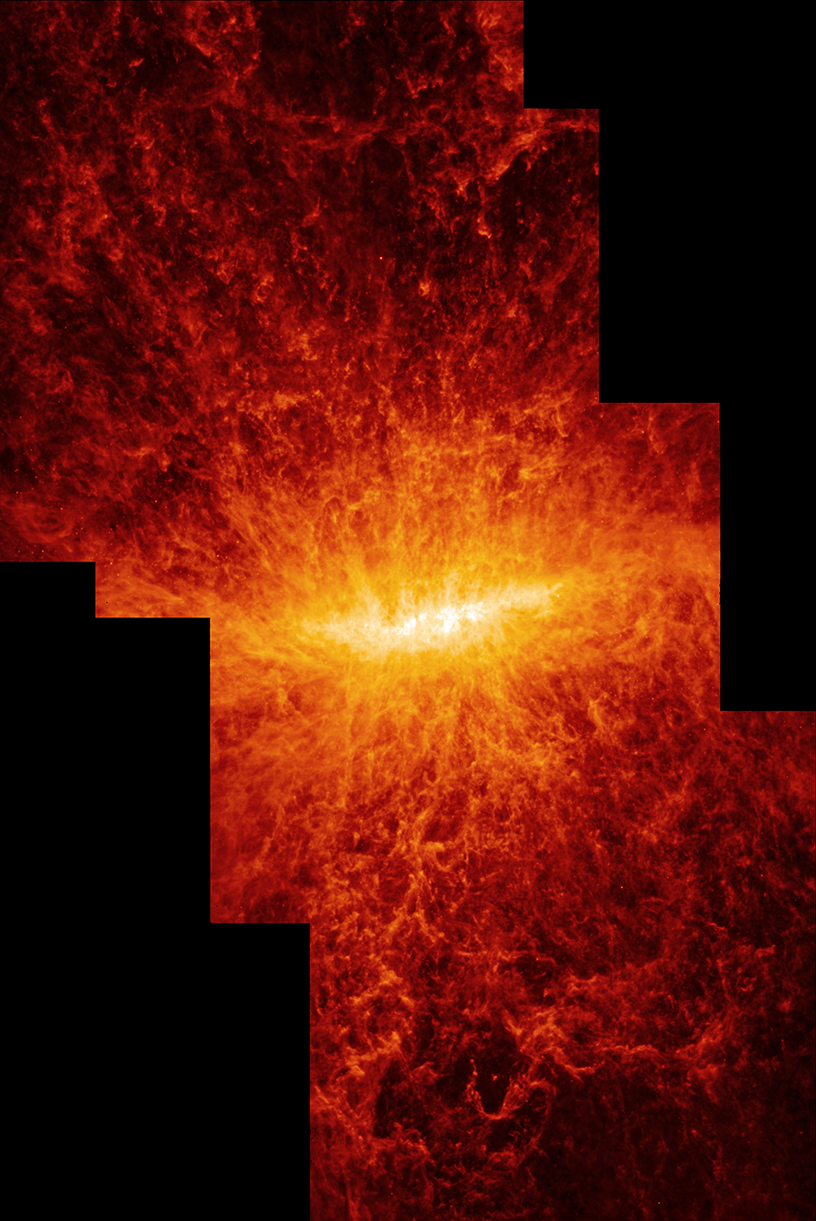
JWST MIRI F770W (7.7μm) imaging of the inner M82 wind. Image Credit: Alyssa Pagan, STScI. Data Credit: ESA/Webb, NASA & CSA, A. Bolatto.